AI is driving venture capital valuations higher, but the industry’s liquidity problem remains unresolved.
Venture capital appears to be recovering. US VC funds reported a 22.8% one-year IRR in Q1 2026, driven largely by the artificial intelligence boom.
But there is a catch: Most of these returns exist on paper.
According to PitchBook’s Q3 2026 US VC Fundraising and Returns Report, investors contributed $54.4 billion to VC funds in Q1 2026 while receiving only $17.6 billion in distributions. That represents a negative net cash flow of $36.8 billion.
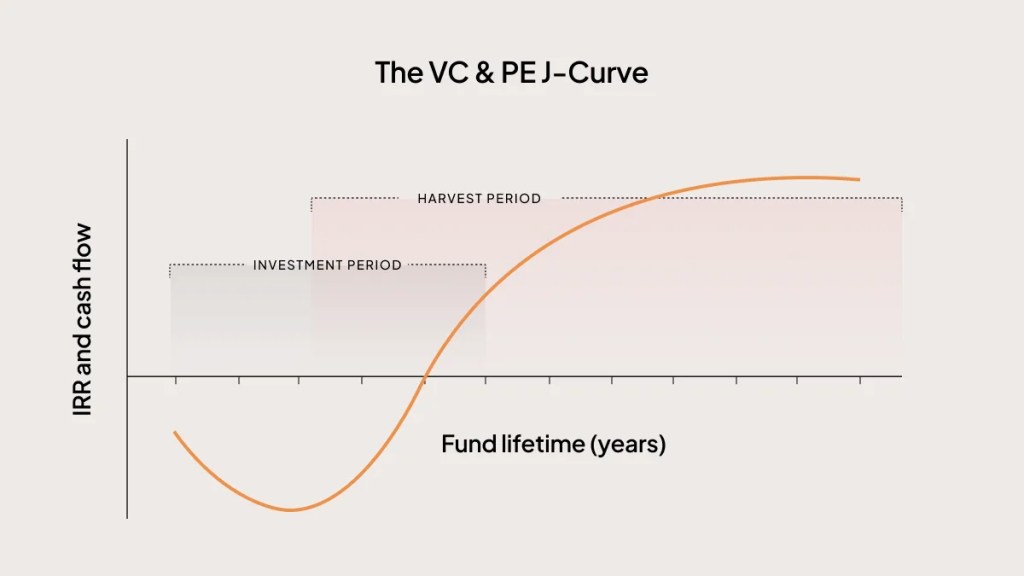
The traditional VC J-curve is getting deeper, with capital remaining invested for longer before generating meaningful cash returns.
AI: The Growth Engine and the Risk
AI accounted for an extraordinary 82.7% of US VC deal value through Q3 2026.
This concentration has helped push valuations and fund returns higher. However, it also creates significant risks. The largest VC funds benefit disproportionately from access to leading AI companies. For example, the 2024 VC vintage reported a pooled IRR of 43.2%, while the median fund achieved just 20%.
A handful of successful investments are increasingly driving overall market performance. If AI valuations correct before investors can realize their gains, the consequences could be significant.
The Liquidity Problem Isn’t Going Away
Despite increasing exit activity, liquidity remains concentrated in a few major transactions. Investors are still waiting for meaningful distributions, and potential IPOs from companies such as Anthropic and OpenAI could become important catalysts.
Meanwhile, higher interest rates make venture capital less attractive relative to other asset classes and increase pressure on valuations. This environment is also reshaping the VC industry.
Established managers captured 88.2% of US VC fundraising through Q3 2026, leaving emerging funds facing a significantly tougher fundraising environment.
The industry is increasingly dominated by large platforms, although specialized smaller funds may still find opportunities through differentiated strategies and access.
To sum up: Paper Returns Are Not Cash Returns
I remain convinced that AI represents one of the most significant technological transformations of our time. But technological breakthroughs do not automatically translate into attractive investment returns.
The biggest risk facing venture capital today is not necessarily a collapse in AI innovation. It is the possibility that valuations have moved too far ahead of sustainable business fundamentals and realistic exit opportunities.
The next phase of venture capital will require greater discipline, a stronger focus on capital efficiency, and more attention to actual liquidity.
Ultimately, venture capital success is not measured by how much a portfolio is worth on paper, but by how much capital investors get back.
And that may be the defining challenge for the next VC cycle.
Source: Kyle Stanford, PitchBook, “The VC J-Curve Has Deepened,” and Q3 2026 US VC Fundraising and Returns Report (November 2026).


Kommentar verfassen