Europe may have missed the first big wave of AI, dominated by American companies. But the next wave could look very different — and play directly to Europe’s strengths.
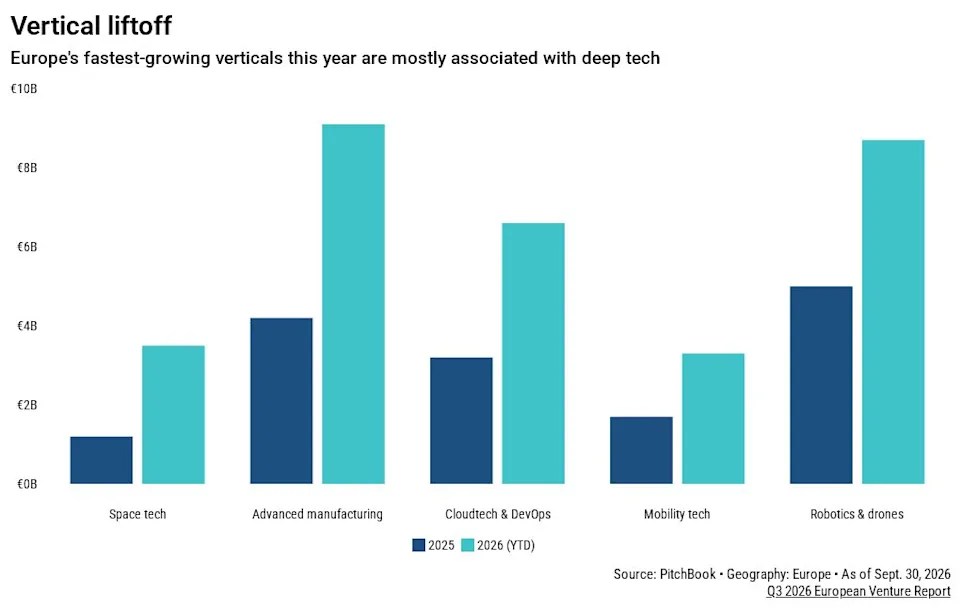
According to PitchBook’s latest analysis, European venture capital is increasingly flowing into deep tech: robotics, space technology, advanced manufacturing, and autonomous systems.
The numbers are impressive:
- Space Tech: Investment could grow by almost 274% compared with last year.
- Advanced Manufacturing: Funding could rise by 189%, reaching €9.1 billion.
- Robotics & Drones: €8.7 billion invested in the first nine months of 2026, compared with €5 billion in all of 2025.
Why Europe Has a Real Opportunity
Europe never built its own Google, Meta, or Amazon. The US had a clear advantage in scaling consumer technology platforms. But Europe has something equally valuable: world-class engineering universities, industrial expertise, and decades of experience in manufacturing, robotics, and precision technology.
And this is where AI is heading next.
AI is moving beyond chatbots into the physical world. Intelligent robots, autonomous systems, smart factories, and advanced materials. These technologies require much more than software. They need sophisticated hardware, engineering expertise, and deep industrial knowledge.
Exactly the areas where Europe can compete.
Geopolitics adds another tailwind. Europe wants greater independence in defense, semiconductors, and critical infrastructure, creating demand for homegrown technology.
The Catch: Innovation Isn’t Enough
Deep tech is expensive. Development cycles are long, capital requirements are high, and commercial success is far from guaranteed. ASML shows what is possible when European engineering creates a lasting technological advantage. But not every deep-tech startup will become the next ASML.
Europe’s real challenge has never been a lack of innovation. It has been turning great technology into globally successful businesses.
My Take
I’m cautiously optimistic. The investment boom is encouraging, but funding rounds don’t create successful companies. Customers, scalable business models, and international competitiveness do.
Europe may have missed the first AI wave. But when AI meets robotics, manufacturing, and the physical world, the cards could be reshuffled.
This time, Europe has a genuine chance to lead.
Source: PitchBook – Deep Tech Dominates Fastest-Growing European VC Verticals


Kommentar verfassen