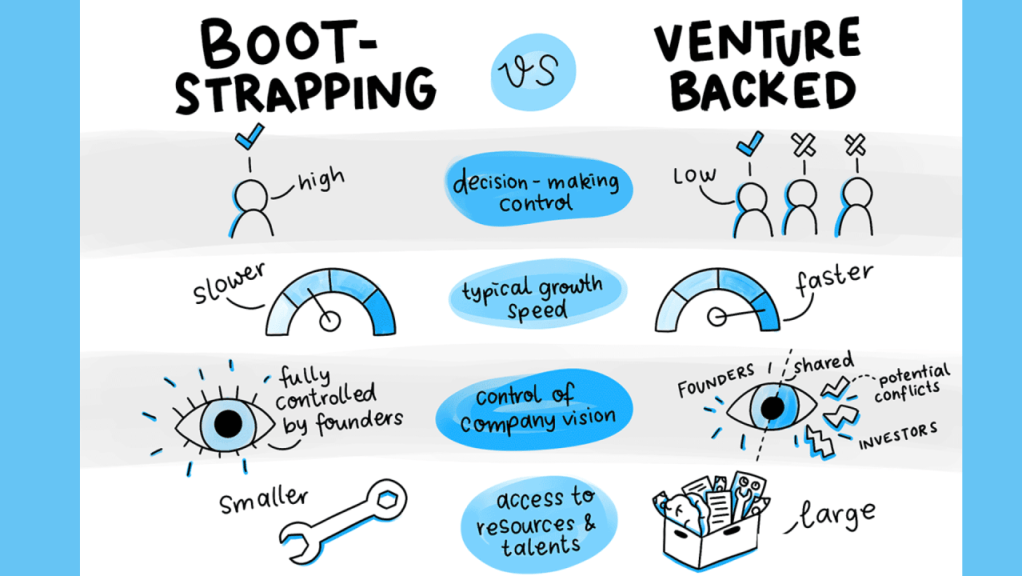
For years, the startup playbook was fairly straightforward: start with a strong idea, build a team, raise capital early and grow as quickly as possible. For software companies, that approach made sense because even getting to a solid first product often required significant resources. AI is changing that equation. Small teams can now build, test and sometimes scale products that would have required far more people and capital only a few years ago. Venture capital isn’t becoming obsolete, but founders can often go much further before they actually need it.
That makes bootstrapping a realistic option for many more companies. If you understand a specific customer problem and people are willing to pay for the solution, revenue can finance a meaningful part of the early journey while giving you very direct feedback on whether the business really works. You learn quickly whether customers value the product, whether pricing is sustainable and whether customer acquisition makes economic sense. With a large amount of external capital, some of those signals can become less clear because growth, hiring and marketing can continue for quite some time even when the underlying unit economics aren’t yet convincing.
None of this means founders should avoid VC. The more useful question is whether capital creates a genuine strategic advantage. If you need significant upfront investment, if the market is being captured quickly, or if speed itself is a competitive advantage, venture capital can be extremely valuable. The same applies when you’ve already found a repeatable go-to-market model and want to accelerate international expansion. The problem isn’t raising money; it’s raising money simply because fundraising has become part of the expected startup journey, or because a large round is treated as proof of success.
A useful question to ask is: What would this company be unable to do over the next two years without venture capital? If you could still build the product, win customers and grow, just somewhat more slowly, it’s worth considering whether dilution and additional growth pressure are necessary yet. Ideally, capital should accelerate an engine that already works rather than automatically funding the search for one.
That may be the biggest change AI brings: more optionality. Founders can get further with smaller teams, reach revenue earlier and decide later whether institutional capital is actually needed. Venture capital remains a powerful tool, but it no longer has to sit at the beginning of the startup journey. For many companies, the better path may be to solve a real problem, win paying customers and prove the business model first and then raise capital when it creates a clear strategic advantage.
 Max Meister
Hinterlasse einen Kommentar