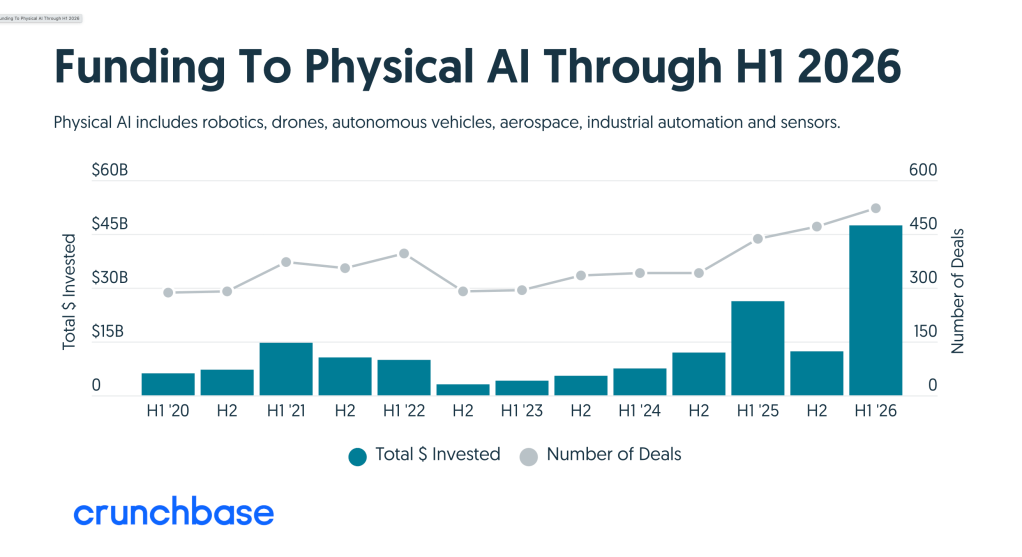
One number stood out in venture capital this week: $47.4 billion was invested in so-called Physical AI companies in the first half of 2026 alone, across 521 deals.
That is almost four times as much as in the second half of 2025 and roughly 80% more than in the first half of last year. Even more striking: From 2022 through 2024 combined, investors put just under $42 billion into the category.
Physical AI — including robotics, autonomous vehicles, aerospace, drones, industrial automation and sensors — is quickly becoming one of the most important new venture capital themes.
But behind the headline numbers, the story is more nuanced. First, it is worth looking at where the money is actually going. Waymo alone raised $16 billion in February. That means a single financing round accounts for roughly one-third of all Physical AI funding in the first half of the year.
Then there are several other mega-rounds: Anduril raised $5 billion, Shield AI raised $2 billion, and Saronic raised $1.75 billion. So the increase is not simply the result of hundreds of early-stage robotics startups suddenly raising huge rounds. A significant share of the capital is concentrated in a small number of already very large companies.
Still, dismissing the trend as a statistical outlier would miss the bigger picture. There is a broader shift happening in venture capital.
Venture capital is moving into the physical world
For years, the classic venture playbook was dominated by software. Software could be built with relatively little capital, distributed globally and scaled at very high margins.
Hardware was different. It meant higher capital requirements, longer development cycles, manufacturing, supply chains and, in many cases, regulatory complexity.
That equation is starting to change. Compute and foundation models have become more accessible. Simulation has improved. Sensors and hardware components have become cheaper. At the same time, smaller teams can move faster because of better software and AI tooling.
None of this means robotics, aerospace or industrial automation have suddenly become easy. But the cost and time required to move from an idea to a functional product are coming down. And that changes the attractiveness of these businesses for venture capital.
Hardware is getting software economics
The more interesting development may be happening at the business-model level.
Many Physical AI companies are no longer simply selling a machine and generating most of their revenue from one-off hardware sales or maintenance. Hardware is increasingly combined with software, data and recurring revenue.
Companies are experimenting with subscription models, usage-based pricing and outcome-based pricing. A robot, autonomous vehicle or industrial sensor system therefore becomes more than just a product. It can also become a distribution channel for software and a generator of proprietary data.
In the best case, that creates a compelling combination:
the defensibility of hardware with some of the economics of software.
That helps explain why investors who historically focused on software are now paying much closer attention to robotics, defense, aerospace and industrial technology.
The new benchmark is production
For me, however, the most important change is happening somewhere else. Over the past few years, many AI companies were able to generate enormous investor interest before it was clear whether they had a durable business model. Physical AI will be less forgiving.
An impressive robot demo is not enough. An autonomous machine has to work reliably outside the lab. An industrial system has to integrate into real customer environments. A hardware company has to manufacture and deliver products. And eventually, customers have to be willing to pay for the outcome.
That is why investor attention is increasingly shifting toward much more practical questions:
- Can the company hit its production milestones?
- Can it deliver products reliably?
- Are there real paying customers?
- And can the business scale economically?
Physical AI may therefore become an important test of how much substance there really is behind the current AI boom.
The strongest moats may span multiple layers
For founders, there is another important implication.
Physical AI is probably not a category you can simply jump into because investors are excited about it. The generative AI boom made it relatively easy to build new products on top of existing models and APIs. In many cases, teams could launch and test a first version within weeks.
Physical AI is different.
Building in robotics, industrial automation, autonomous systems or aerospace often requires deep technical expertise, access to real-world environments, manufacturing capability and very specific domain knowledge.
But that difficulty may also create stronger companies. One particularly interesting thesis is that the best moats will emerge at companies that control several layers of their technology stack and integrate vertically.
Not just an AI model. Not just software. Not just hardware.
But a combination of technology, proprietary data, hardware, infrastructure and deep understanding of the application itself. A thin AI wrapper around a robot is unlikely to create a durable company — just as a thin wrapper around a large language model rarely creates a lasting moat.
That is why I would not tell founders to start a “Physical AI company” simply because more venture capital is moving into the category. The capital is a signal that something structural is changing.
It is not evidence that these companies are easy to build. Quite the opposite. The strongest opportunities are likely to emerge where founders have exceptional domain knowledge, understand a real and expensive problem, and can use technology to fundamentally improve a difficult physical process. That is much harder than building the hundredth AI SaaS product.
But that difficulty may be exactly what makes the opportunity interesting.
After Generative AI comes Physical AI
A few months ago, I wrote about venture capital rediscovering the physical world. The latest funding numbers show just how quickly that shift is accelerating.
Physical AI may indeed become one of the next major venture capital categories. But the most interesting question is no longer whether investors are willing to put billions into robotics, autonomy, defense, aerospace and industrial technology. They clearly are.
The real question is: Which of these companies can turn impressive technology into reliable production, real customers and a scalable business model?
Because in the physical world, the best demo does not win. The company whose technology actually works does.


Kommentar verfassen